
Can Clear Aligners Fix Overbite, Underbite & Crowding?

Straightening teeth is not always just about appearance. The way your upper and lower teeth fit together can affect your bite, chewing, and how evenly forces are distributed across your teeth.
If you have an overbite, underbite, or crowded teeth, you may be wondering whether clear aligners can correct the problem.
In many cases, clear aligners can address certain orthodontic concerns. However, the answer depends on the severity and cause of the problem.
If you are considering clear aligners in North Quincy, MA, an evaluation at Spring Dental can help determine what treatment options are realistic for your smile.
Understanding the Different Problems
What Is an Overbite?
An overbite occurs when the upper front teeth overlap the lower front teeth vertically.
Some overlap is normal. The concern arises when the overlap is excessive or associated with other dental or bite problems.
Certain dental overbites can be improved with clear aligner treatment by changing the position of the teeth and their relationship with one another.
However, not every overbite is caused by tooth position alone.
What Is an Underbite?
An underbite occurs when the lower front teeth sit in front of the upper front teeth when you close your mouth.
The cause can involve tooth position, jaw development, or a combination of factors.
If the problem is primarily related to the position of the teeth, clear aligners may be able to make meaningful improvements in appropriate cases.
A significant skeletal underbite may require a different approach.
What Is Crowding?
Crowding occurs when there is not enough room for teeth to line up properly.
Teeth may overlap, rotate, or sit outside their ideal positions.
Clear aligners can correct many forms of mild to moderate crowding by gradually creating space and repositioning teeth.
The amount of crowding and the way space needs to be created determine whether aligners are appropriate.
Why the Cause Matters
Two people can have what looks like the same orthodontic problem but need different treatments.
Consider two patients with an overbite.
One may have teeth that are positioned too far forward. Another may have a significant difference in jaw structure.
Clear aligners primarily move teeth. They cannot correct every underlying skeletal problem.
That is why a proper examination is more useful than trying to determine your eligibility from photographs or an online questionnaire alone.
How Clear Aligners Can Address Crowding
Crowding is one of the common concerns associated with clear aligner treatment.
Depending on the case, treatment may involve gradually changing the positions of individual teeth to create a more orderly arrangement.
Your dentist may also use specific techniques to create or redistribute space.
The exact approach depends on how crowded your teeth are and where the available space exists.
Can Clear Aligners Correct an Overbite?
They can correct some types of overbite.
Treatment planning may involve changing the vertical and horizontal relationships of the teeth. Attachments or other planned features may be used when additional control is needed.
The goal is not simply to make the front teeth appear more even. Your provider needs to consider how the upper and lower teeth meet after treatment.
Can Clear Aligners Correct an Underbite?
Certain mild underbites may respond to clear aligner treatment.
However, the distinction between a dental underbite and a skeletal underbite is particularly important.
If the jaw relationship is the primary issue, aligners alone may not be sufficient.
In a more complex case, your dentist may recommend consultation with an orthodontist or discuss another treatment approach.
What If You Have More Than One Problem?
It is common for patients to have a combination of orthodontic concerns.
You might have crowding in the lower teeth along with an overbite. Another patient may have spacing combined with a crossbite.
Your treatment plan needs to address the overall relationship of your teeth rather than treating each problem as though it exists separately.
How Is Your Case Evaluated?
Dental Examination
Your provider will examine your teeth, gums, and bite.
Digital Scanning
A digital scan can create a detailed three-dimensional model of your teeth and may be used for treatment planning.
X-Rays
X-rays can provide information about tooth roots, supporting bone, and other structures that cannot be assessed from the tooth surfaces alone.
Bite Assessment
Your provider will look at how your upper and lower teeth contact one another.
Together, these findings help determine whether clear aligners can provide the desired correction.
What If Aligners Cannot Fully Correct the Problem?
That does not mean you cannot receive treatment.
Traditional braces may provide additional control for certain movements. An orthodontic referral may also be appropriate for more complex cases.
A responsible treatment recommendation is one that considers what can be achieved predictably rather than promising that clear aligners can fix every bite problem.
What Happens If You Do Nothing?
Some mild alignment issues may not cause significant problems. Others can contribute to difficulty cleaning, uneven tooth wear, or functional concerns.
The impact depends on the individual.
Your dentist can explain whether treatment is recommended for cosmetic reasons, functional reasons, or both.
Find Out if Clear Aligners Are Right for You
If your crowded teeth or bite has been bothering you, there is no reason to guess whether clear aligners can help. Spring Dental can evaluate your teeth and explain your orthodontic options based on your individual needs.
Contact Spring Dental, a dental clinic in North Quincy, MA, to schedule a consultation and learn more about clear aligner treatment.
FAQs About Clear Aligners and Bite Problems
Can clear aligners fix a severe overbite?
It depends on what is causing the overbite. Some dental overbites can be treated with aligners, while severe cases involving jaw structure may require additional treatment.
Can clear aligners fix an underbite completely?
Some mild dental underbites can improve with aligners. A skeletal underbite may require treatment beyond clear aligners.
Can clear aligners fix crowded teeth?
Yes, many mild to moderate cases of dental crowding can be treated with clear aligners. The amount and location of crowding are important factors.
Can aligners fix a crossbite?
Certain crossbites can be treated with clear aligners, particularly when the issue is related to tooth position. More complex cases may require another orthodontic approach.
Will clear aligners change my bite?
They can. Treatment planning considers how the upper and lower teeth fit together, not just their appearance.
Do I need braces if my bite problem is severe?
Not necessarily, but your provider may recommend braces or referral to an orthodontist if aligners cannot provide adequate control.
Can clear aligners fix teeth that overlap?
They can correct many types of overlapping teeth when there is sufficient space and the required movements are achievable.
How do I know whether my bite problem is caused by my teeth or jaw?
A dental examination and diagnostic records can help identify the cause. It is difficult to determine this accurately without an in-person evaluation.
Visit Our Clinics
Choose your nearest clinic location.

Available Days: Tuesday, Wednesday, Friday, and Saturday
Phone Number: 617-328-0790
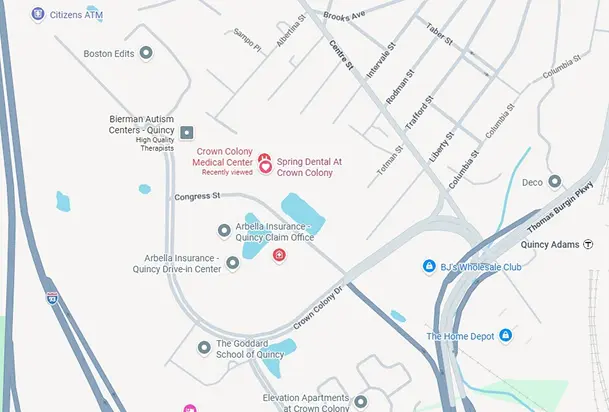
Available Days: Monday & Thursday
Phone Number: 617-984-0044


Overview
Services
Support
Privacy Policy | © 2026 Spring Dental | All Rights Reserved | Digital Marketing by Remedo